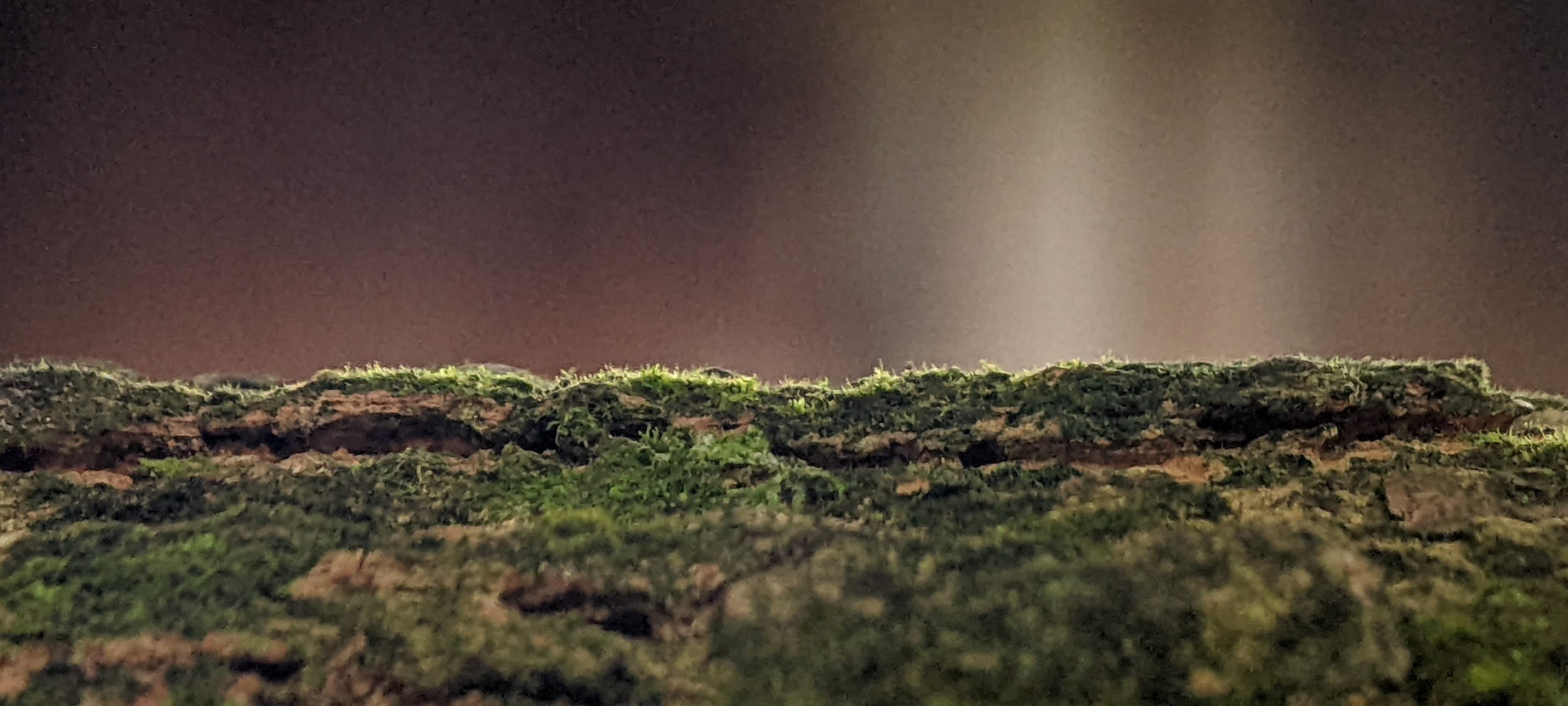
Black streaks on a Montreal roof are almost always algae, and they remain primarily an aesthetic issue. Thick moss and lichen, however, trap water against the shingles and require prompt attention.
Key points
- The black streaks on asphalt shingles come from blue-green algae, not mold.
- The moss lifts the shingles and traps moisture; it is what shortens the roof's lifespan.
- The lichen anchors itself into the granules and leaves scars when removed.
- Montreal receives about 1,000 mm of precipitation per year, which is more than enough to fuel colonization on a poorly sunlit slope.
- The use of a pressure washer should be avoided on a shingle roof: it removes the protective granules.
- The products used are governed by Quebec's Pesticides Act and by municipal regulations.
- Any contractor climbing onto your roof must hold a valid RBQ license, which can be verified online for free.
- Roof cleaning is no substitute forpreventive maintenance : gutters, drains, ventilation, and tree trimming address the root cause.
What is actually growing on your roof in Montreal
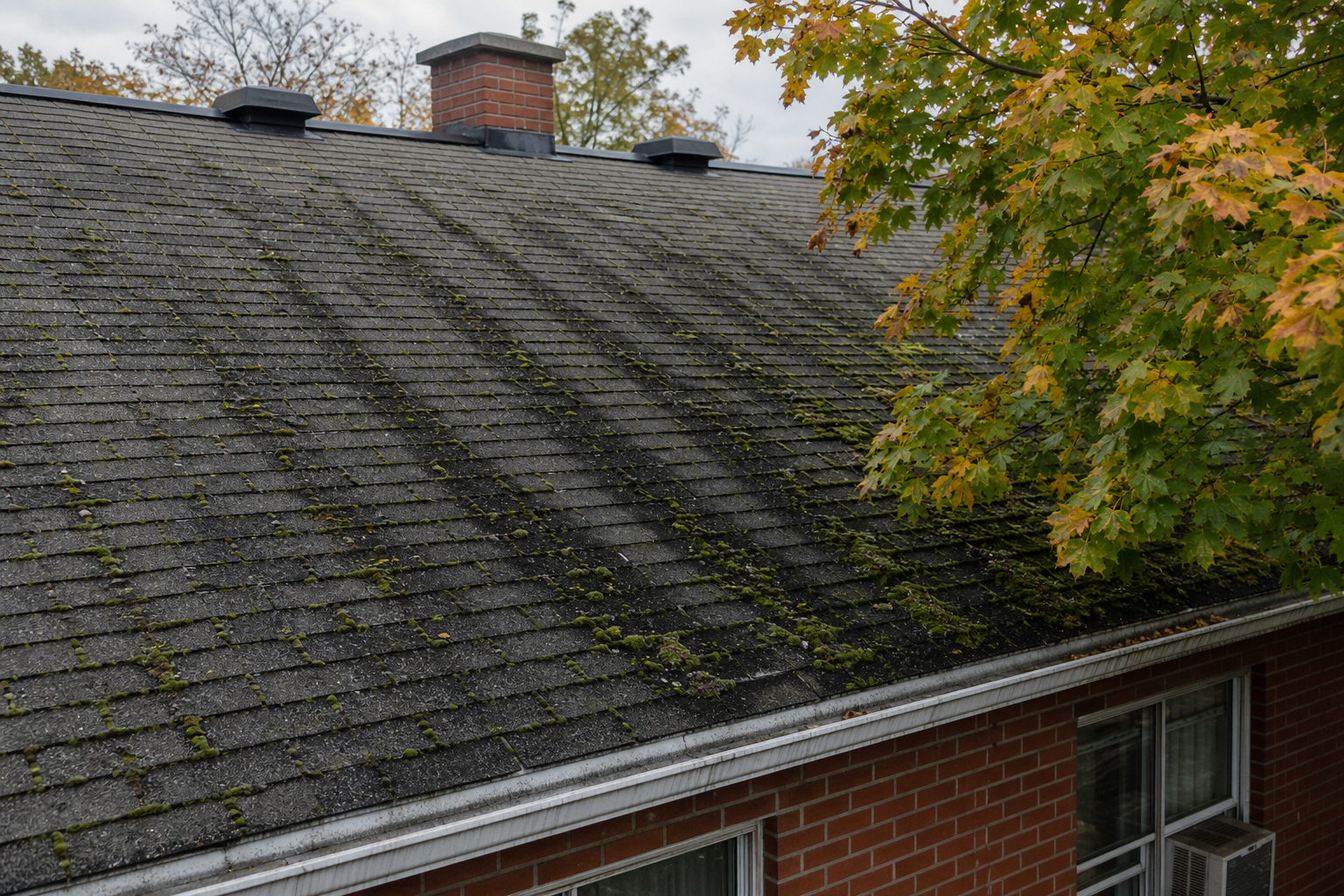
Three different organisms colonize roofs, and they each require a different response. Blue-green algae form gray or black streaks that run down with rainwater, especially on north-facing slopes and under tree overhangs. Moss, which is green and spongy, settles into the joints between shingles and in hollows where water pools. Lichen, appearing in gray or orange patches, is the most stubborn: it anchors itself mechanically into the bitumen.
On the island, this trio thrives due to a humid climate, hot summers, and the dense tree canopy in residential neighborhoods. A roof shaded by a mature maple tree dries several hours later than an exposed one, and that prolonged moisture makes all the difference.
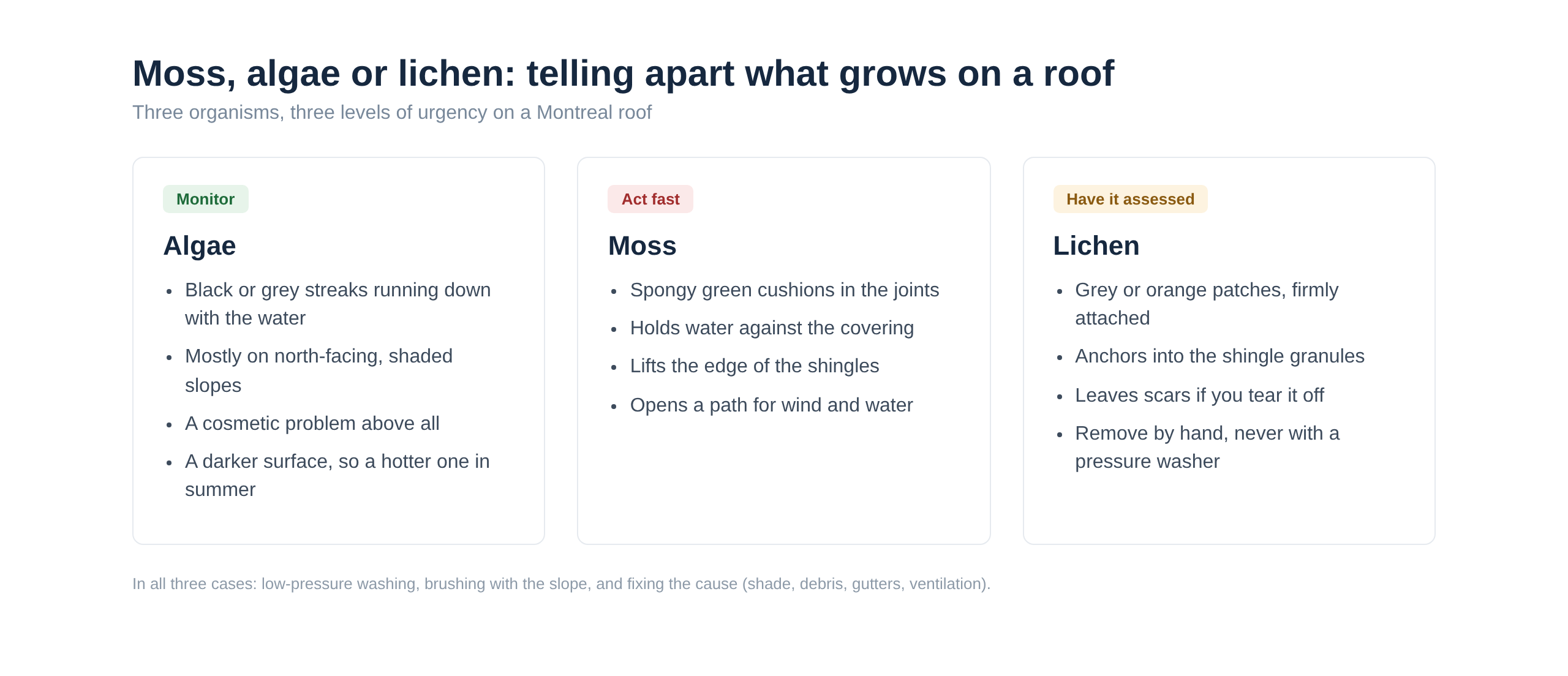
Three organisms, three levels of urgency.
Does it actually damage the roof?
The answer depends on the organism and the material. Algae cause staining without degrading the shingle structure in the short term; their most measurable effect is surface darkening, which leads to a slight increase in roof temperature during the summer. Moss is a different story: as it swells with water, it lifts the bottom edge of asphalt shingles, creates a path for wind and water, and keeps the roof deck permanently damp. On slate or cedar shingle roofs, this same retained moisture accelerates the degradation of fasteners.
On flat roofs covered with an elastomer membrane, moss is rarer, but the debris accumulations that feed it can block the drain. A clogged drain turns an ordinary rain shower into a pool of standing water on the membrane.
Conditions that accelerate colonization
Four factors come up in almost every inspection. First, permanent shade, whether from trees or a neighboring building. Next, organic debris: needles, leaves, and samaras form a bed that traps water. Insufficient attic ventilation also plays a role, as a warm, damp roof deck promotes condensation under the roofing material. Finally, clogged gutters force water back toward the first row of shingles, exactly where the moss starts.
This is why a moss problem is rarely solved with a single cleaning. As long as the root cause remains, the colony will return in two or three seasons.
Cleaning without damaging the surface
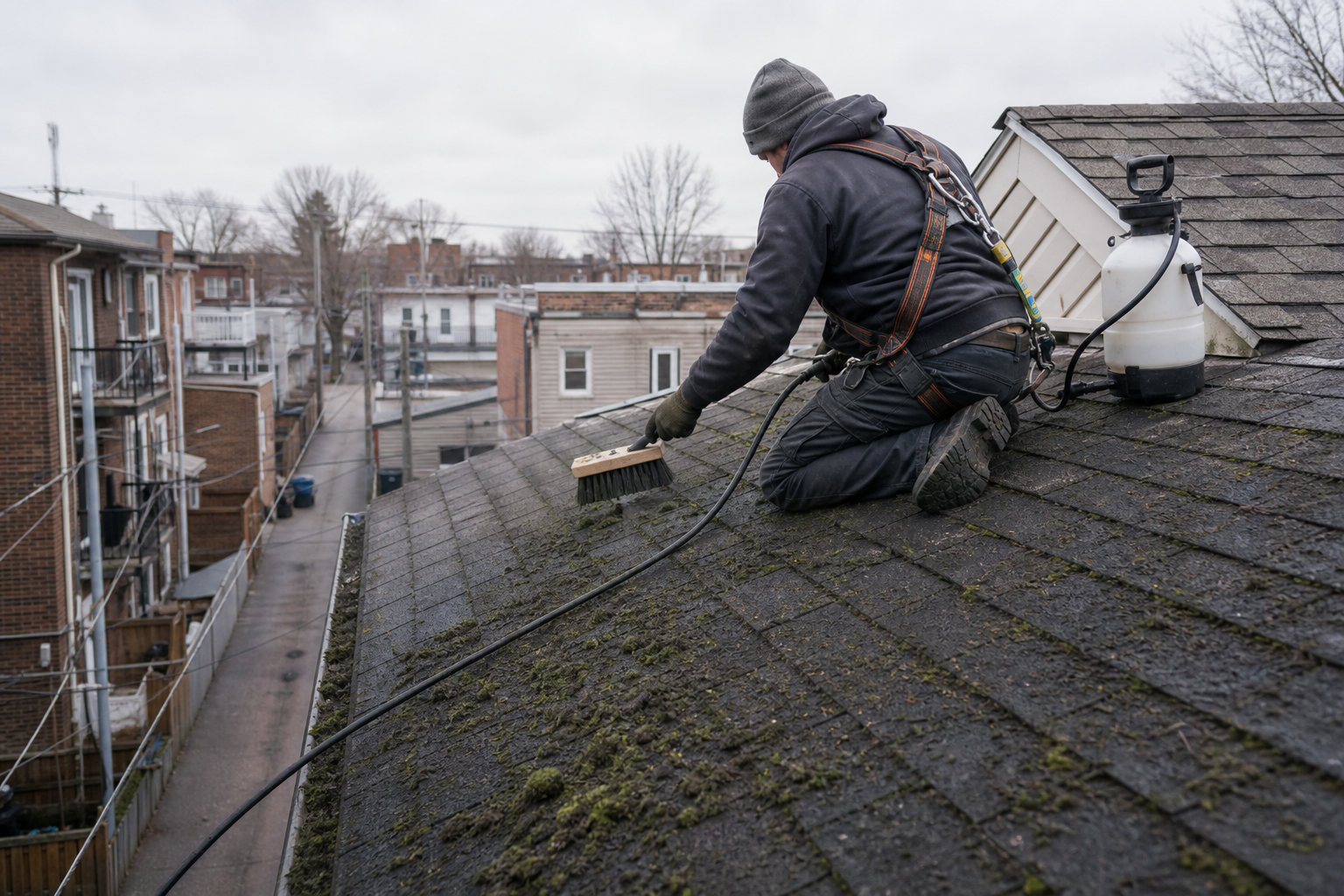
The method depends first on the material. On asphalt shingles, cleaning is done at low pressure, without high-pressure washing, using a solution that is applied and then gently rinsed, along with soft brushing in the direction of the slope. Never against the grain, and never with a concentrated jet: every granule lost is a loss of UV protection.
On slate and cedar, we work even more gently, by hand, accepting that some of the patina will remain. On a membrane roof, the main priority is removing debris and clearing drains, while wearing clean shoes and avoiding dragging tools that could cause punctures.
The work is performed at heights, often on surfaces that become slippery when wet. This is the main reason to entrust the job to a properly equipped team rather than climbing up there yourself on a Saturday morning.
Products: what Quebec regulations allow
Solutions sold to kill moss and algae are considered pesticides under the law. In Quebec, their sale and use are governed by the Pesticides Act and its associated regulations, and the government reminds us that many municipalities add their own restrictions for domestic use. Before buying a product, you must therefore check two levels of rules, not just one.
There is also the issue of your immediate neighbors: what is rinsed off the roof ends up in the gutters, then on the ground, on a lawn, in a vegetable garden, or on a shared driveway. A product that is too harsh can also damage plants and aluminum surfaces.
Prevention is better than repeated cleaning
Prevention involves simple, long-lasting measures. Trim back branches overhanging the roof brings back sunlight and reduces debris. Cleaning gutters twice a year prevents water backup on the first row. Correcting deficient attic ventilation tackles the problem from underneath.
There are also solutions installed directly on the roof. A zinc or copper strip installed near the ridge releases metal ions with every rainfall, which inhibits regrowth on the surface below. The effect diminishes with distance, so a single strip will not protect a large slope. When replacing your roof, you can also choose shingles designed to resist algae, which contain copper in their granules.
Roof cleaning: what a roofing crew does
Roof cleaning is not the same as pressure washing a facade. A roofing crew begins by inspecting the covering, noting the condition of the asphalt shingles, flashings, and the roof structure visible from the attic, then chooses the method based on what they find. On residential roofs in Montreal, this means a low-pressure wash, often described as a soft wash treatment, and never a high-pressure water jet that would damage the shingles.
Cleaning normally includes clearing the gutters and, on flat roofs, the drain. This is the least visible part of the service and the most useful: water that drains quickly does not feed moss or algae. A professional team finishes with a report of the weak points observed, including photos, rather than just a simple before-and-after.
The price of a roof cleaning varies depending on the surface area, slope, accessibility, and condition of the covering. Always ask for a written estimate and check if it includes the gutters; otherwise, comparing two quotes is meaningless.
Cleaning, repair, or replacement: where does your roof stand
Three scenarios arise after an inspection. If the covering is still in good condition, cleaning and maintenance work are sufficient, and the roof's lifespan continues as normal. If a few sections are damaged, targeted repair of the shingles and flashings solves the problem without touching the rest. If the roof is at the end of its life, replacement becomes the only cost-effective choice: cleaning a covering that is already losing its granules only delays the inevitable by a few months.
For a Montreal plex, the issue of attic insulation and ventilation almost always comes up in the same file. A poorly ventilated attic traps moisture, promotes condensation inside, and creates the exact conditions that moss loves on the outside. Fixing the ventilation at the same time as the cleaning saves you from paying for two service calls.
When to call a roofer
Three signs justify calling roofing specialists rather than just doing a cosmetic cleaning: thick moss that is visibly lifting the shingles, patches of lichen on an aging roof, and signs of moisture inside, in the attic, or on the ceiling. In these cases, cleaning is not the solution; it is the step that follows a professional assessment of the roof's actual condition.
Before hiring anyone, take thirty seconds to verify the contractor's license in the Régie du bâtiment du Québec registry. A roofer who refuses to provide their license number is a major red flag.
Not sure what's growing on your roof?
We go up, identify it, and tell you if it can be cleaned or if the roofing material is already compromised. Montreal and Laval.
Contact us to book an appointment before it's too late.
Frequently asked questions about roof moss